
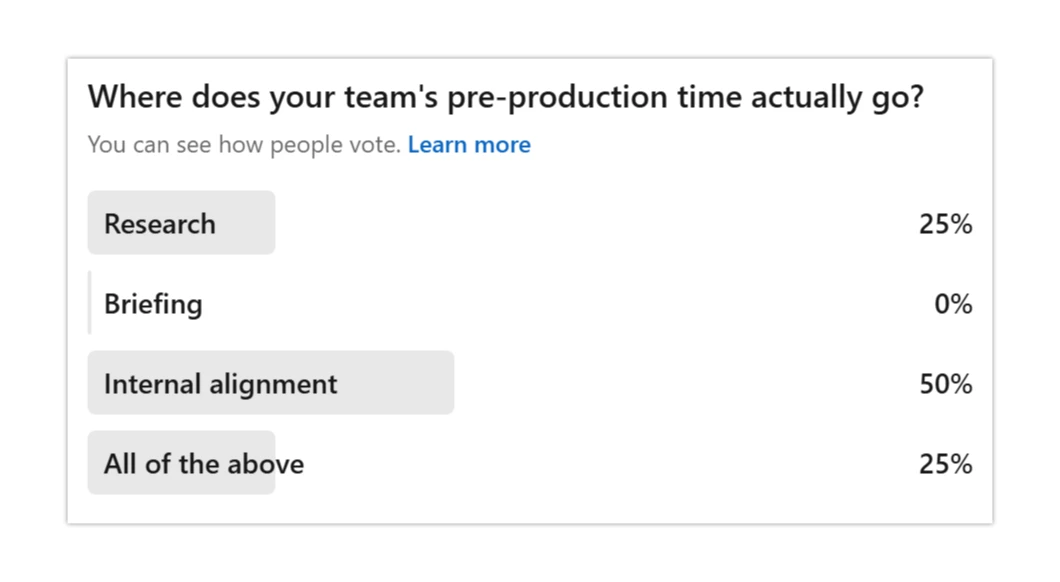
We ran a simple poll on LinkedIn asking agency professionals a straightforward question: where does your team's pre-production time actually go? The options were research, briefing, internal alignment, or all of the above. The results were telling — but not for the reasons most people might expect.
of agency teams report spending pre-production time on briefing
Research claimed 25% of responses. Internal alignment dominated at 50%. A further 25% said all of the above. But briefing? Zero percent. Not a single respondent said their team dedicates pre-production time to the brief. At first glance, that might read as a sign of a lean, efficient operation — teams skipping the bureaucracy and getting straight to the work. It is not. It is one of the most expensive blind spots in the agency industry.
The core argument is this: skipping or underfunding the briefing process does not eliminate friction from a project. It simply relocates that friction to later — where it is far more damaging, far more expensive, and far less visible on a proposal. The time will be spent one way or another. The only question is whether agencies spend it deliberately upfront, or reactively downstream in the form of rework, re-alignment, and eroded margins.
The Ripple Effect of the Missing Brief
Internal Misalignment: The 50% Time Sink
Look again at that poll result: 50% of agency pre-production time goes to internal alignment. Half of everything before a project formally begins is consumed by teams trying to agree on direction, scope, audience, and objectives. This is not a people problem or a culture problem — it is a structural one. When there is no single, authoritative brief acting as the project's source of truth, alignment cannot happen once. It happens continuously, in fragments, across every meeting, Slack thread, and review session.
Without a structured brief to anchor the team, every creative decision becomes a negotiation. Copywriters interpret the client's goals one way. Strategists interpret them another. Account managers are trying to triangulate between both while managing client expectations in parallel. The result is a project that is perpetually re-centering itself — burning hours that were never budgeted, on conversations that should have happened before a single word of copy was written.
Internal alignment meetings are not a symptom of a disorganised team — they are a symptom of a missing brief. Fix the root cause, not the symptom.
Surface-Level Messaging That Lands Flat
When research is conducted but never properly distilled into a brief, it does not disappear — it gets absorbed informally by whoever happens to have read it most recently. Creative teams end up writing for composite, generic personas stitched together from half-remembered discovery notes and gut instinct. Internally, this work can look perfectly competent. It hits the expected marks. It passes review. And then it enters the market and simply does not connect.
The brief's job is to take everything learned during research and sharpen it into a precise creative directive. Without that sharpening step, campaigns default to the safe middle — messaging broad enough that it offends no one internally, but specific enough to resonate with no one externally. This is how agencies produce technically correct work that still fails to capture the spirit of a client's product or audience.
The Unbillable Rework Loop
Unfocused campaigns create a predictable downstream consequence: client revisions. Not the natural, productive kind of revision that refines good work — but the costly, demoralising kind that signals a fundamental misalignment between what the agency thought the client wanted and what the client actually needed. Extra variants get produced. Messaging is re-written from scratch. Post-launch troubleshooting begins. And none of it was ever line-itemed on the original proposal.
This is where agency margins go to die. The rework loop is not dramatic enough to show up as a single catastrophic loss — it accumulates quietly, project by project, in unbillable hours that were never anticipated because no one traced them back to their origin: a briefing phase that was skipped entirely.
Agency margins don't collapse in one disaster. They erode quietly, revision by revision, in work that was never budgeted because the brief was never written.
Reframing the Brief: It's Not Paperwork, It's the Strategy Engine
Briefing Is Alignment
The most persistent misconception about the briefing process is that it adds time to a project. The opposite is true. Two structured hours spent on a proper brief reliably eliminate four or more hours of mid-project alignment meetings, because the brief answers — definitively and in writing — the questions those meetings would otherwise be convened to debate. Who are we talking to? What is the single most important thing we need to communicate? What does success look like, and how will we measure it? These are not small questions. They are the load-bearing questions of every project, and without a brief, they get answered slowly, expensively, and often incorrectly.
Framed this way, the brief is not a deliverable that precedes the work — it is the first and most consequential act of strategic alignment. It brings the client, the account team, the strategists, and the creative team into the same mental model before a single asset is produced. That shared model is what allows projects to move with confidence rather than constant recalibration.
Setting the Creative Perimeter
A strong brief establishes three things with clarity: the target audience, the core messaging pillars, and the success metrics for the campaign. These three elements define the creative perimeter — the bounded space within which copywriters and designers can work with genuine freedom, because they understand exactly what the work is trying to achieve and who it is trying to reach. Without that perimeter, creative freedom is not freedom at all. It is ambiguity, and ambiguity produces work that has to be revised.
The best creative teams do not want fewer constraints — they want smarter ones. A well-constructed brief provides exactly that: a clear target, a defensible strategic rationale, and a shared definition of what a successful outcome looks like. That foundation is what allows a team to move from good to genuinely excellent, because they are not spending creative energy on questions the brief should have already answered.
Protecting the Client Relationship
Clients rarely re-hire agencies that fail to capture the spirit of their product. That phrase deserves to sit for a moment, because it names the actual competitive risk behind a missing brief. It is not just about this project's margins or this campaign's revision count. It is about whether the agency demonstrates, consistently and early, that it truly understands what a client is building and why it matters to their audience.
The brief is the primary tool for achieving that. It is the document that proves — to the client, before production begins — that the agency has listened, synthesised, and understood. When clients review a well-constructed brief and recognise their own product in it, trust is built. When campaigns launch without one and the work misses the mark, that trust does not easily return.
A well-written brief is proof of listening. It shows clients their product was understood — before a single asset is produced.
How Agencies Can Fix the Pre-Production Gap
The poll result is a diagnosis, not a verdict. The briefing gap is a structural problem, which means it has structural solutions. Three changes, applied consistently, can shift an agency's pre-production practice from reactive to deliberate.
Formalize the Briefing Phase
The first and most important step is to stop treating the briefing phase as an informal transition between the sales process and production. It is not a handshake or a quick internal download — it is a distinct, structured milestone with its own inputs, outputs, and sign-off requirements. That means putting it on the project timeline explicitly, assigning it to a named owner, and requiring client approval before the creative phase begins. When briefing is invisible on a project plan, it gets skipped. When it is a named milestone with a deadline, it gets done.
Systematize to Save Time
One reason teams avoid formal briefing is that it feels like it takes too long to do well. The solution is systematisation. Standardised briefing frameworks and purpose-built briefing tools allow teams to move through the process quickly and consistently, without starting from a blank page every time. When the structure already exists, the effort shifts from building the format to filling it with quality thinking — which is exactly where that time should go. A repeatable briefing process is one that does not feel like a burden, because the cognitive overhead of figuring out how to do it has already been solved.
Scope Realistically
Perhaps the most commercially significant change is this: stop absorbing the briefing phase as overhead. Discovery, synthesis, and brief development are foundational strategic work, and they should be scoped and priced accordingly. Agencies that treat these activities as unpaid prerequisites to the real work are training clients to expect them for free — and then quietly losing money on every project to compensate. Building structured pre-production time into project planning, and being transparent with clients about its value, is not just good practice. It is how agencies protect their margins while delivering better work.
- Make briefing a named milestone on every project timeline, with a clear owner and client sign-off required before production begins.
- Adopt a standardised briefing framework so the process is fast, repeatable, and consistent across accounts.
- Scope and price discovery and briefing as billable strategic work — not as overhead absorbed into production budgets.
- Treat the approved brief as the single source of truth throughout the project, referencing it actively in creative reviews and client presentations.
The Time Will Be Spent Either Way
Pre-production time does not disappear when the briefing phase is skipped. It resurfaces — as misalignment meetings, as creative that misses the mark, as revision rounds that eat into delivery timelines and margin. The poll result that started this conversation is not evidence that agencies have found a more efficient path. It is evidence of a widespread habit of deferring a necessary cost to the worst possible moment in a project's life.
The agencies that invest deliberately in a structured briefing phase are not adding overhead — they are front-loading the strategic clarity that every project requires anyway. They are choosing to have the hard, important conversations before production begins, rather than during it. And they are protecting something that no revision budget can recover: the client's confidence that their agency truly understood the assignment from the start.
Pre-production time will be spent one way or another — either upfront in a structured brief, or downstream in revisions, re-alignment, and lost margins.
How does your agency handle the briefing phase? Is it a formal milestone, an informal conversation, or something that quietly gets absorbed into other parts of pre-production? We'd genuinely like to know — share your biggest pre-production bottleneck in the comments, or reach out directly. The zero-percent result is a starting point for an industry-wide conversation that is long overdue.