Skip to content

One brief. A complete campaign, built per audience.

DayClerk is an AI campaign platform that simulates how your specific audience segments think and behave, then generates the landing page, email copy, ad assets, and social content to match. No research team. No agency. No generic output. You go from a one-line brief to a published campaign in under 15 minutes.

Example scan

Start with a page you already own

34
Losing most visitors
Social proof
No reviews or trust logos shown above the fold.
Lasting impression
Confirmation page is a blank "Thanks" with no next step.
Momentum to convert
Progress bar clearly shows step 2 of 3.

Four tools. One simulation driving all of them.

Before any content is created, DayClerk models how each audience segment behaves, their friction points, drop-off risks, and content expectations. Everything generated flows from that intelligence, so every asset is built for a real person, not a hypothetical crowd.

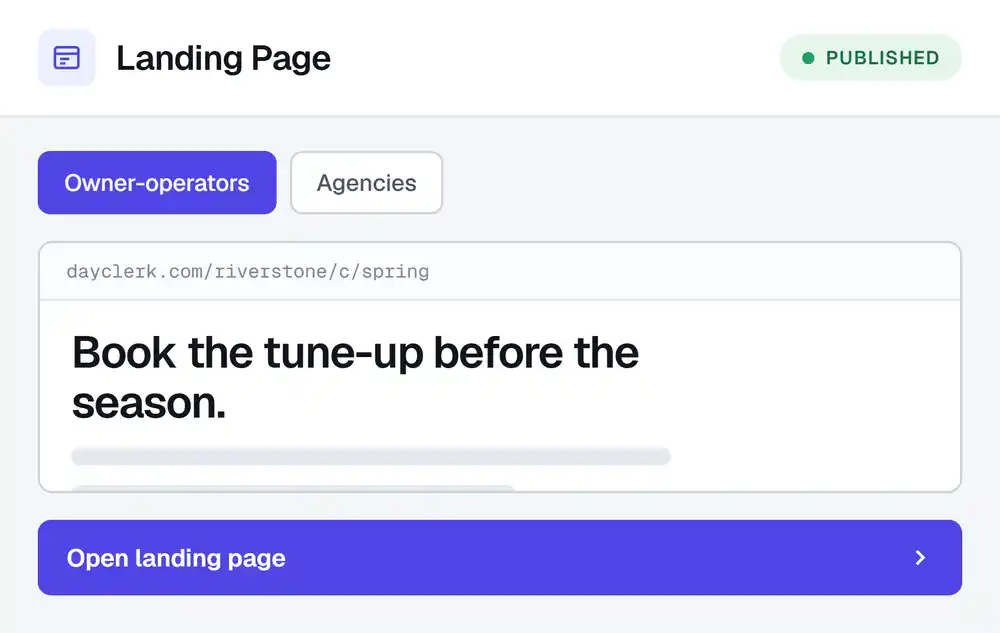
Landing Page Wizard

A segmented page, live in under 15 minutes.

A segmented page, live in under 15 minutes.

  • Separate page variant per audience segment
  • Published to dayclerk.com/{handle}/c/{slug}
  • Inline editor for copy and CTA labels
Learn more →

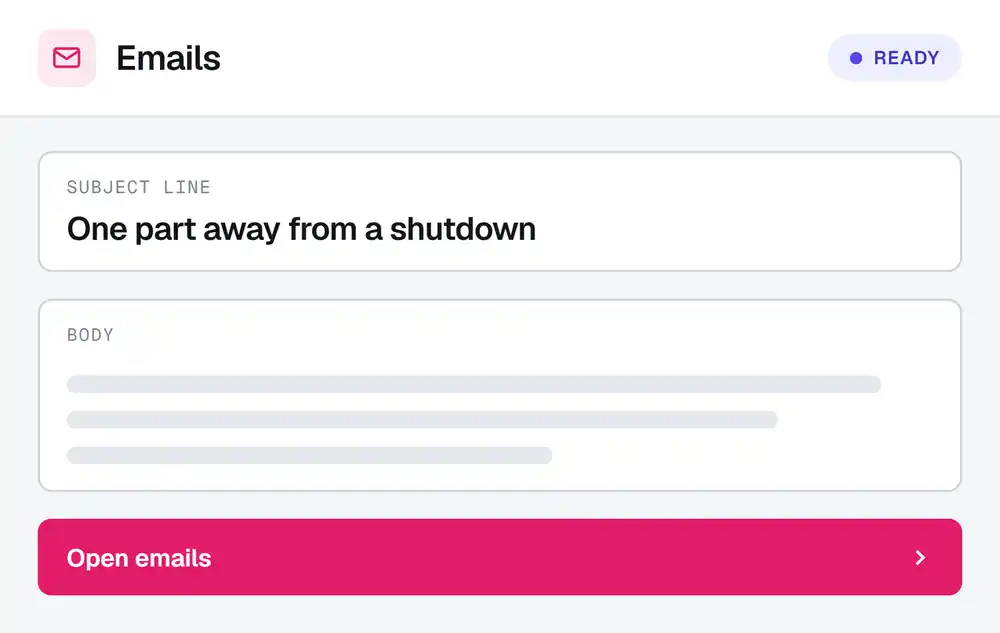
Email Architect

Segment-specific email copy, ready to send.

Segment-specific email copy, ready to send.

  • Subject line, preview text, body, and CTA included
  • Promotional, informational, and nurture types
  • Downloadable as HTML for your ESP
Learn more →

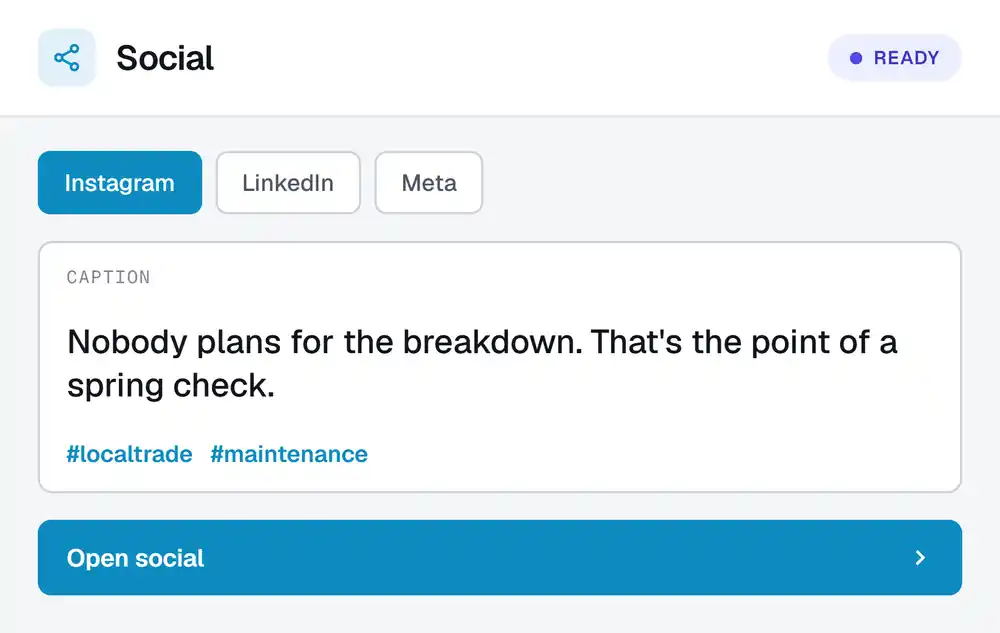
Social Studio

Platform-ready copy for every channel you use.

Platform-ready copy for every channel you use.

  • Copy generated per platform and per segment
  • Captions, hashtags, headlines, and descriptions
  • Copy-paste ready output
Learn more →

ad generator

Paid ad copy that keeps its promise and converts.

Paid ad copy that keeps its promise and converts.

  • 4 platforms in one generation: Meta, Google Search, LinkedIn, TikTok
  • Weak angles flagged before you spend a dollar
  • Ready to paste straight into your ad manager
Learn more →

Check out these example campaign pages you could launch today.

Skeptical of what segmented, AI-generated campaigns actually look like? DayClerk generates landing pages from real briefs across different business types and audiences. Browse them to see the quality, the segmentation, and the format before you commit to anything.

Create impactful brand awareness campaigns
bRAND Awareness

Create impactful brand awareness campaigns

DayClerk generates awareness landing pages designed around how your target audience evaluates unfamiliar brands, surfacing the trust signals, proof points, and messaging angles most likely to build recall with each segment.

See Example →
01 / 05

What early users are saying

For someone who has worked serving customers, the results of the simulation were very scary accurate. As a small business, I'm absolutely using it for myself. I would use it because it's flexible and quick.
I'm understanding now what the value of this tool is. It shows the likely behavior path. I love how you got clear match scores. For smaller businesses that cannot afford to hire a company who does this sort of analysis for you, this is great.
The solutions it recommends are great. The friction points, everything, is very clearly worded. Looking at the solutions specifically makes me want to take action. It's reassuring because it shows what I might miss as part of planning my campaigns.

Honest answers to the questions you actually have.

If you're skeptical of AI marketing tools, these are the questions worth asking first.

DayClerk generates segmented landing pages published to a live URL, email copy downloadable as HTML, and social copy for Google Search, Meta Paid, Facebook Organic, Instagram Organic, and LinkedIn. It does not schedule or publish social posts, send emails, manage ad campaigns, or automate email sequences. You get the copy and the page — distribution stays in your hands.

Each audience segment receives a genuinely different version — different module order, copy tone, CTA strategy, and email angle — because DayClerk runs a behavioral simulation per segment before writing a word. The simulation models friction points, drop-off risks, and content expectations specific to that segment, so the output reflects how that group actually thinks, not a generic approximation.

The 15-minute figure covers the time from submitting your brief to having a published landing page, email copy, and social posts ready. DayClerk handles the simulation, generation, and publishing automatically. You can edit any element inline after generation, but the complete first draft is live before you'd finish a single creative brief manually.

You start with a one-line brief describing your offer and audience. DayClerk's simulation builds from there. No templates to configure, no research to upload, and no prior marketing expertise required to get a complete, segmented campaign out the other side.

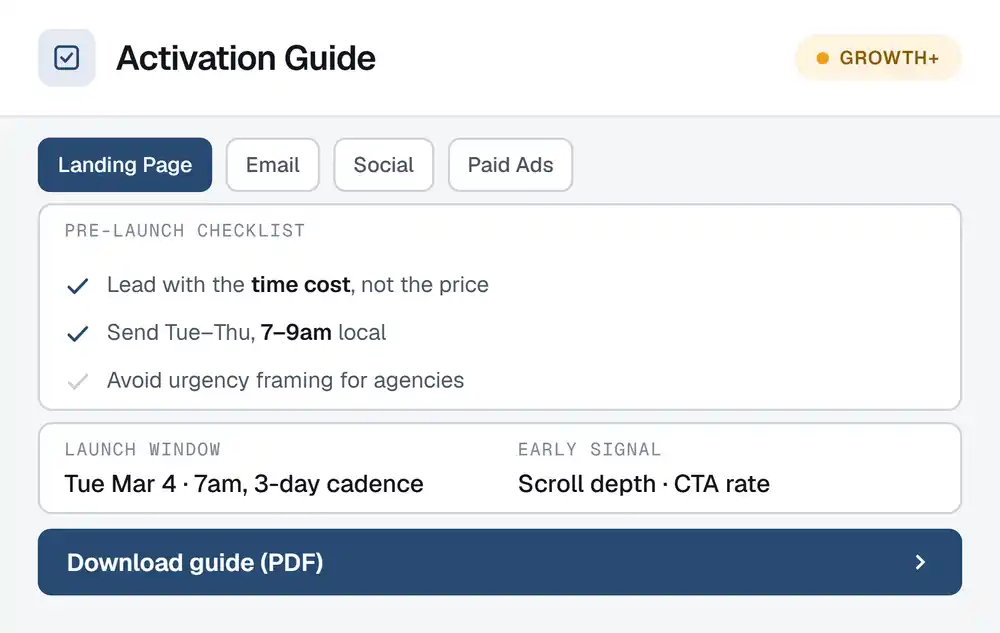
DayClerk offers four tiers: Explorer (free, with core features and limited generations), Growth (more campaigns with email generation unlocked), Pro (adds the Optimization Engine and PDF exports), and Agency (unlimited optimization, auto-apply, and up to 10 segments per campaign). There is no enterprise tier or custom pricing.

DayClerk is built for SMB owner-operators running campaigns without a dedicated marketing team, marketing agencies managing multiple client accounts who need to scale output without scaling headcount, and affiliate creators who need campaign assets that match their voice. If you currently rely on a freelancer or agency to produce campaign copy, DayClerk is designed to replace that dependency.

DayClerk integrates with Mailchimp. Subscribers collected through landing page newsletter forms sync directly to your Mailchimp audience with tag-based segmentation to separate promotional from informational subscribers. No other email platforms are currently supported.

Yes. Every landing page includes an inline editor where you can update headlines, body copy, CTA labels, and images after generation. The page remains live at your branded URL while you make changes, so you're never starting from scratch or waiting on a rebuild.

No — DayClerk isn't a general-purpose website builder like Wix or Squarespace. It's an AI campaign platform: you run an audience simulation, and DayClerk generates a segmented landing page from those insights — along with matching email and social copy — rather than handing you a blank canvas to design a site yourself. The page is inline-editable after generation, but it's one output of the campaign engine, not a standalone site-building tool.

01Social proofCialdini, Influence: The Psychology of Persuasion (2021)thedecisionlab
02ScarcityCialdini, Influence: The Psychology of Persuasion (2021)en
03AuthorityCialdini, Influence: The Psychology of Persuasion (2021)thedecisionlab
04ReciprocityCialdini, Influence: The Psychology of Persuasion (2021)en
05Commitment and consistencyCialdini, Influence: The Psychology of Persuasion (2021)en
06UrgencyCialdini, Influence: The Psychology of Persuasion (2021)en
07Loss aversionKahneman & Tversky, Prospect Theory (1979)thedecisionlab
08AnchoringTversky & Kahneman, Judgment Under Uncertainty (1974)thedecisionlab
09Framing effectTversky & Kahneman, The Framing of Decisions and the Psychology of Choice (1981)thedecisionlab
10Endowment effectKahneman, Knetsch & Thaler (1991)behavioraleconomics
11Status quo biasSamuelson & Zeckhauser, Status Quo Bias in Decision Making (1988)en
12Paradox of choiceSchwartz, The Paradox of Choice (2004)en
13Decoy effectHuber, Payne & Puto, Adding Asymmetrically Dominated Alternatives (1982)thedecisionlab
14Hick's lawHick (1952); Hyman (1953)lawsofux
15Cognitive loadSweller, Cognitive Load During Problem Solving (1988)en
16Serial position effectEbbinghaus (1885); Murdock (1962)lawsofux
17Peak-end ruleKahneman, Fredrickson, Schreiber & Redelmeier (1993)nngroup
18Halo effectThorndike, A Constant Error in Psychological Ratings (1920)britannica
19Mere-exposure effectZajonc, Attitudinal Effects of Mere Exposure (1968)simplypsychology
20Goal-gradient effectHull (1932); Kivetz, Urminsky & Zheng (2006)lawsofux
20 principles in the current library, across 7 independent source familiesSee the full library →
See all FAQs →

Your next campaign should not start with a blank page.

Free to start. No credit card required.