
In the world of branding, a monogram is more than a set of initials. It is a condensed narrative — one shape that carries the character, values, and promise of an entire organization. For DayClerk, the interlocked "CD" monogram was designed around a single principle: that the shape created by the two letters together should communicate more than either letter could alone.
What you see in the final mark is not the first version. It is the fourth. Each iteration answered a question that the previous one raised — and understanding that progression reveals something about what the mark is actually doing.
From concept to mark: the progression
The designer began with a clear constraint: retain the letters D and C, and find the best possible relationship between them. What followed was a series of deliberate experiments in placement, order, and color — each one moving toward something that was not just visually correct, but behaviorally right.
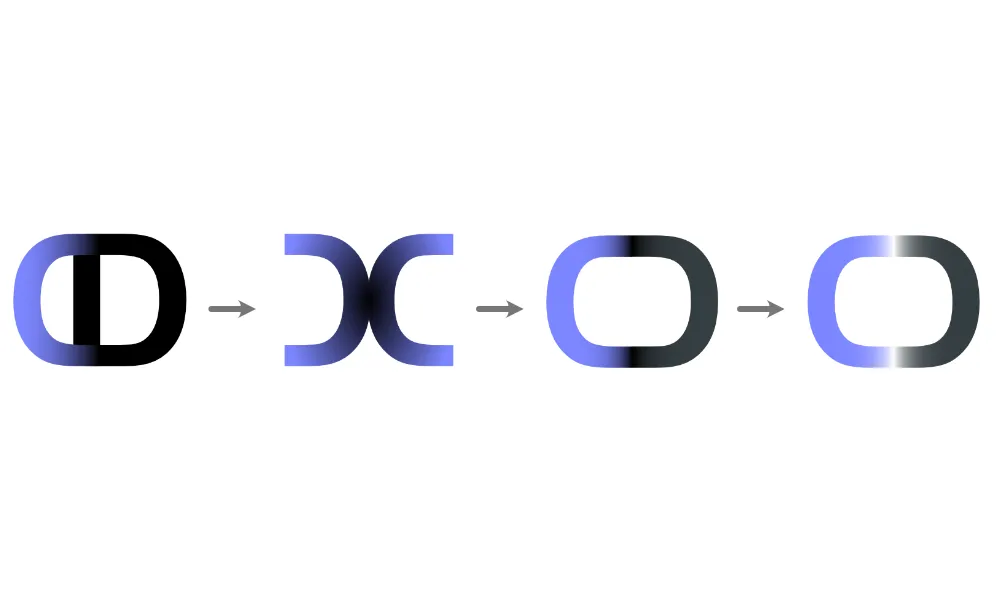
Stage 1 — Superposed with bar
The first version placed the D and C layered on top of each other — superposed. The bar running through the center of the mark was not an added structural element; it was the horizontal stroke of the letter D itself, carrying over from the letterform into the composition. The off-center placement of that bar created something genuinely interesting: viewed from a certain angle, it resembled a store counter seen from above, an accidental echo of the historical day clerk's workspace that felt almost too right to be coincidental.
But the bar remained the problem. Even though it originated from the D, it was too dominant in the composition — it drew the eye and held it in a way that competed with the letters rather than serving them. The bar said "division" when the mark needed to say "connection." It was a striking shape, but the wrong kind of striking.
Stage 2 — The letters opposing each other
The second attempt moved away from superposition entirely and tried the opposite: placing the D and C facing each other symmetrically. The result was technically balanced but emotionally wrong. The opposing orientation read as an X — it felt confrontational, not welcoming. For a brand built around trust and daily support, a mark that looked like a crossing-out was the opposite of the right signal. It was abandoned quickly.
Stage 3 — Bar removed, the embrace emerges
Removing the bar — stepping back to the superposed configuration but letting the D's stroke recede — revealed something neither previous version had managed: an enclosed shape that read as a single unit. Without the dividing line, the two letters stopped competing and started containing each other. The C opened toward the D; the D settled into the C. Even though the letters appear in the order C-D — reversed from "DayClerk" — the shape does not feel backward. It feels like an embrace.
This was the conceptual breakthrough. The final version refines the weight, balances the aperture, and introduces the white joint — but the essential character of the mark was decided the moment the bar came out.
The mark does not read as D and C — it reads as a single enclosed shape. That is where the identity lives.
The logic of the out-of-order layout
A common question about the DayClerk monogram is why the C appears to lead — rather than D for Day. In professional monogram design, the visual relationship between shapes takes precedence over the alphabetical sequence of the initials. What matters is the structure the shapes create together, not the order in which you read them.
Strategic containment
The C is an open aperture — a curved arm that extends toward the center and leaves space. Placed on the left, it acts as a cradle for the D. The D, with its flat vertical spine and curved belly, fits into that space and completes the enclosure. The result is a shape that feels locked rather than assembled.
The closed loop
Together, the two letterforms create a closed loop — a shape without an obvious entry or exit point. Psychologically, this communicates security and completeness, qualities that matter for a service built around reliability and daily trust. If the D were placed first, its flat vertical spine would create a wall through the center of the mark, making it feel open on one side and closed on the other. The design would "leak."
The Precision Link: slate and periwinkle
The two-tone color strategy is not a day-and-night metaphor, even though the product is called DayClerk. The colors were chosen for what they communicate technically and emotionally — and for how they function together across light and dark backgrounds.
Periwinkle blue — the action layer
Periwinkle represents clarity, focus, and active execution. It is the color of the "Clerk" half of the mark — the doing side, the part of the product that generates campaigns, surfaces recommendations, and takes visible action on behalf of the user.
Deep slate — the foundation layer
Deep slate communicates professional weight, security, and permanence. It is the color of the "Day" half — the grounding side, representing the audience intelligence and behavioral foundation that makes the action layer meaningful. Without the slate, the periwinkle would be energy without direction.
The adaptive white joint
Between the two halves, a thin gap of adaptive white light runs through the center of the mark. On dark backgrounds it reads as a bright seam; on light backgrounds it softens to a near-invisible transition. This "Precision Link" represents the simulation layer — the moment where AI processes intent before content is generated. It is also what allows the mark to hold its structural integrity at any size and on any background color without losing its identity.
Recognition over reading
The most enduring monograms in brand history — Chanel's interlocking C, Rolls-Royce's stacked RR, Louis Vuitton's tessellated LV — share one property: you stop reading them as letters and start seeing them as shapes. The letter-ness becomes secondary to the form.
The DayClerk monogram aims for that same transition. The goal was never to make people consciously process a "C" and a "D." It was to make them see a single, enclosed, stable mark — one that over time becomes associated with the product's character: reliable, precise, always present, quietly working.
The DayClerk monogram is effective because it moves past "reading" and into "recognition." By prioritizing a balanced, interlocked shape over a standard left-to-right reading order, the brand presents itself as a cohesive tool — not just a "C" and a "D," but a single, indestructible link in the user's daily operations.