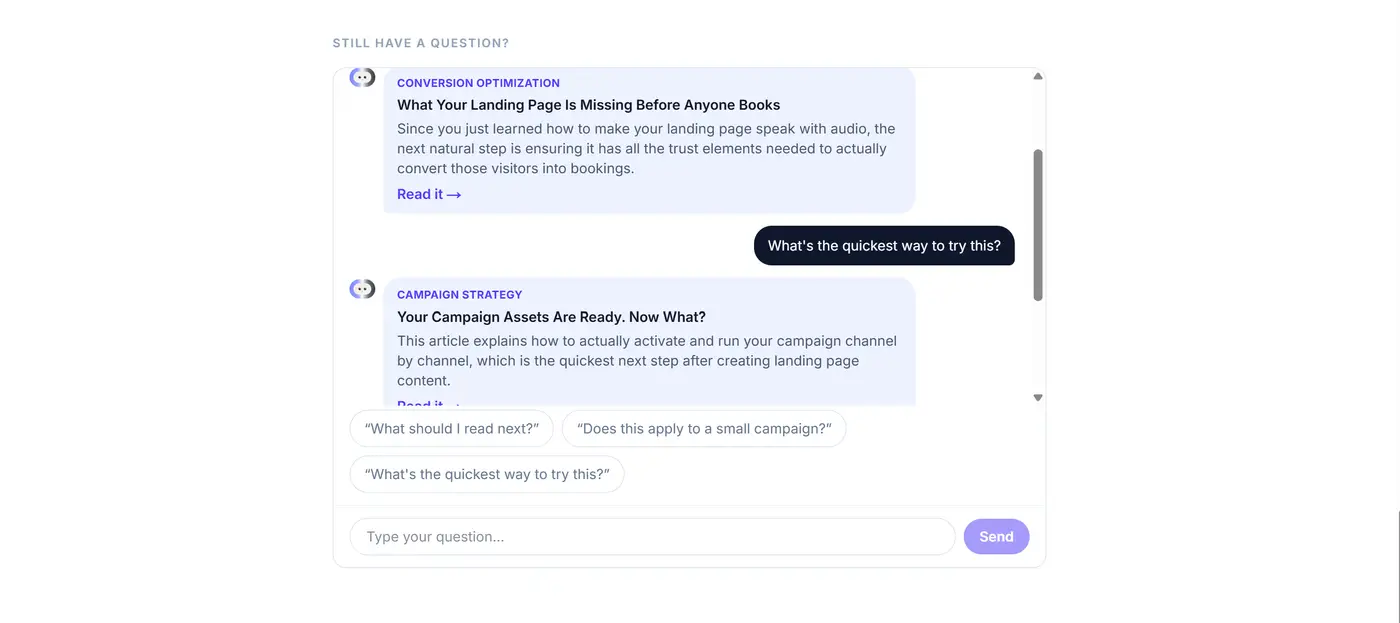
You finish reading an article, and there's almost always a moment right after where you have one more question the piece didn't quite answer. Maybe it covered the main topic well but left something specific hanging. You glance at the "related articles" section underneath, scan three headlines, try to guess which one — if any — actually addresses what you're wondering, and click hoping for the best. More often than not, you end up somewhere only loosely connected to what you actually wanted to know. DayClerk articles now skip that guessing game entirely: when you still have a question, you can just ask.
The Problem With 'Related Articles'
Most blogs end with a grid of links chosen by topic tag — a blunt instrument that groups articles by broad category rather than by what you, specifically, are likely to wonder next. The result is a small pile of headlines that may or may not have anything to do with the question still sitting in your head.
That leaves the work squarely on you. You read the headlines, make your best guess, click through, and hope. Sometimes you get lucky. Often you don't, and you're back where you started — or you've wandered so far from your original question that you've lost the thread entirely.
Topic tags tell you what an article is about. They don't tell you what you'll want to know next — and that's the gap that 'related articles' almost never closes.
The frustrating part is that the question you have after reading an article is usually quite specific. It's not "show me more articles in this category" — it's something particular that the piece you just read raised but didn't answer. A generic recommendation grid simply isn't built to handle that kind of specificity, and no amount of scrolling through suggested links is going to change that.
What Changes for You
At the bottom of every DayClerk article, you'll now find a small chat with Clerxy. You can type your follow-up question in your own words, or tap one of the suggested prompts if one of them happens to match what you're thinking. Either way, the interaction is quick and low-effort — it's designed to fit naturally into the moment right after you finish reading, not to send you down a separate research path.
What you get back is deliberately simple: exactly one recommendation. Not a list of five possibilities to evaluate, not a category page to browse — just the single article that actually answers your question, along with a brief note explaining why it's the right one. That context matters. Knowing why something is being recommended helps you decide in seconds whether it's worth your time, rather than having to click through and find out.
One answer, one recommendation, one short explanation of why — so you spend your time reading, not deciding what to read.
There's no account to create and no sign-in required. Clerxy is available to anyone reading the article, right there on the page. And if your question genuinely doesn't have a good match in DayClerk's library, Clerxy will tell you that honestly rather than pointing you somewhere unhelpful just to appear useful. That honesty is the point — a recommendation that doesn't actually answer your question isn't a recommendation, it's just noise.
A No-Pressure Way to Stay in the Loop
Sometimes one follow-up question leads naturally to another, and if you find yourself asking a couple in a row on the same topic, Clerxy will offer something small: the option to receive a curated list of recommended reads sent directly to you as soon as you subscribe. It's a single, quiet offer — not a pop-up that interrupts your reading, not a prompt that appears after every question.
You can say no thanks, and that's the end of it. You won't be asked again. If you do subscribe, you're signing up only for the topic you were actually curious about in that moment — not a general newsletter you never requested, not a broad category you have only passing interest in. The scope stays exactly as narrow as your original question, which means if you do start receiving emails, they're genuinely relevant to something you were already thinking about.
You're only ever signing up for the topic you asked about — nothing broader, nothing you didn't choose.
Next Time You Have a Question, Just Ask
The next time you finish a DayClerk article and find yourself still sitting with a question, you don't have to scroll through a grid of links and guess. Just type what you're wondering. Clerxy will point you somewhere that actually helps.